




Showing posts with label Traditional Martial Arts. Show all posts

Saturday, November 15, 2025

Excellence is a Choice

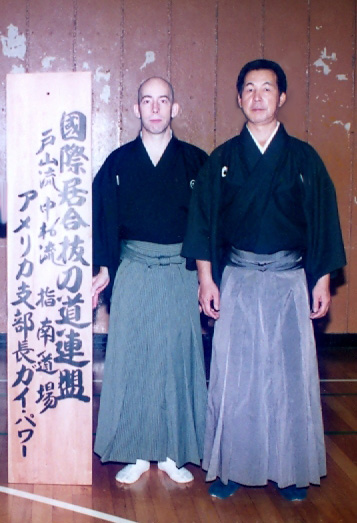
A photo of two martial artists posing at their local martial arts organization.
Have you ever encountered a martial arts master that didn’t seem to fit the archetype of wisdom and
integrity?

Here’s what Sensei Wayne Muromoto has to say:

I looked upon my iai sensei in Kyoto with deep respect and affection. After I left Japan, we continued to write and correspond in between my visits back. He answered my questions about the history, theory, and techniques of iai, and encouraged me to dig further—to study the philosophy and spirituality behind budo. To him, a person’s nationality was no barrier to budo training, even though he had suffered through a Manchurian prisoner-of-war camp under the Russian Communists before he returned to Japan at the end of World War II. As long as you were serious about training, he would teach you.

However, when he passed away, I was told that I was no longer welcome to train at the main dojo. One of my Japanese sempai was oblique as to the reason why, and I didn’t find out until I encountered several other people in the same situation that I discovered the real answer. The sensei who took over the organization hated anyone who wasn’t a native Japanese, myself included.
That is why, if you find a good teacher—one who is not only technically proficient but also a decent human being—you stay with him or her. They are not the norm, just as excellence is not the norm in any endeavor. But in such a short lifetime, why not seek excellence? Anything less wouldn’t be worth it.


Looking to Join a Martial Arts Organization?


SMAA is a martial arts organization for all martial artists who want to be part of a community of dedicating to keeping the spirit of budo alive. If you love your art and want to share it with others, give us a call at (734) 720-0330 or submit a contact form to talk about joining!

Saturday, November 1, 2025

Wise Masters: Fact or Fiction?

A photo of martial artists posing at their local martial arts organization.
Do you think of martial arts masters as fonts of wisdom?

Here’s what Sensei Wayne Muromoto has to say:

One of the notions that many people have is that martial arts masters are wise in the ways of the world. The appeal of the original Karate Kid movies, starring the late Pat Noriyuki Morita, or the Kung Fu series starring David Carradine, lay partly in the fact that the martial arts teachers could not only kick butt, but also dispensed wisdom as they kicked butt. 

That’s a nice positive stereotype—but not always true, unfortunately. And it’s one we have to guard against as martial arts students looking for good instruction. Budo sensei are not necessarily good personal role models, those movies notwithstanding.

The basic concern of most martial arts training is becoming technically proficient in one’s art style. Of course, in budo, it is hoped that by adhering to this long and arduous regime of physical and mental self-discipline, one’s spirit also is polished and refined as a matter of course.


Looking to Join a Martial Arts Organization?


SMAA is a martial arts organization for all martial artists who want to be part of a community of dedicating to keeping the spirit of budo alive. If you love your art and want to share it with others, give us a call at (734) 720-0330 or submit a contact form to talk about joining!

Wednesday, October 15, 2025

Solo Kata Systems and Free Exchange

A photo of two black belts practicing at a Japanese martial arts association.
When is it appropriate to improvise in kata training?

Although in kata geiko (“forms training”) it’s best to try to perfect the kata as is, unless you are aware of the possibility of your partner “breaking” the form and going at you in a different way, you’re just going through the motions. You don’t have the right frame of mind of being focused on executing the right counter to the right attack. That’s why solo kata exercises are great for developing your own stance, balance and timing, but it’s a good idea to also include partner-based training or some form of free exchange. For kata-based systems, going overboard with “free exchange” might taint the style with too much emphasis on sports budo. But sans that, working in kata with different partners, who have different heights, weights, timing, and attack patterns is a decent way to develop the ability to adjust one’s form.

Thus, if you look at the few solo-type kata styles, such as iaido, karate-do, or even a Chinese art like Tai Chi Ch’uan, the solo exercises are always augmented in some way with partner-based training. You never know what a partner will think of doing, even in a regulated exercise. Your distancing, angles of counter, and attacks will change according to your partners.


Grow Your Skillset at a Japanese Martial Arts Organization


SMAA is a martial arts organization dedicated to preserving traditional Japanese budo in the west. To get more details about joining, call (734) 720-0330 or submit a contact form here.

Wednesday, October 1, 2025

Adapting Your Kata

A photo of a black belt practicing at a Japanese martial arts organization.
When you practice kata, do you think about improvising?

We’ve stressed the importance of repetitious training in order to be “natural.” Kata training is really glorified repetitive drill training (well, it’s more than that, but mainly it’s drilling) that is supposed to embed movements and reactions into your body and mind, so that you don’t need to spend precious amounts of time cogitating over whether or not to block, say, a sword stroke at your head or scream like a little girl and just die. Hopefully, through such training, you won’t curl up and die should the actual time arise.

On the other hand, you may have trained incessantly for a specific action, but when the time comes, the situation is not quite right, and your technique needs to be altered in order for it to work. For martial artists who have a component of training with a resistive partner (as in sparring), “catch as catch can” action-reaction is nearly second nature. No partner is going to let you apply that chokehold perfectly without resistance in judo mat work, for instance. So, you improvise. For kata-based training, however, developing this ability to improvise is a bit more problematic, but still important nevertheless. Not everyone is going to come at you with a perfect forward-leaning stance so you can throw him magnificently in a kote-gaeshi, for example. In a self-defense situation, you may have to improvise a lot to get that throw to work.


Grow Your Skillset at a Japanese Martial Arts Organization


SMAA is a martial arts organization dedicated to preserving traditional Japanese budo in the west. To get more details about joining, call (734) 720-0330 or submit a contact form here.

Monday, September 15, 2025

The Basics of Budo: Relaxation and Physics

A photo of a martial artist posing with a sword, practicing aikido at a Japanese martial arts association.
How do relaxation and physics factor into your budo practice?

Here’s a quick guide to these important basics:

Relaxation


Martial artists, like those engaged in most other physical activities, must learn to relax. Tension is your enemy. After developing the ability to do some basic techniques in a relaxed fashion, the techniques must be practiced thousands of times to imprint the movements into the body and the brain. But the practitioner must always be relaxed.

If you want to throw a good front punch, you must relax your upper body including the muscles in your face. Do a small experiment, please. Try to get a tense, tough, mean look on your face and simultaneously try to completely relax your upper body.

You can’t. It’s impossible. Your face and your upper body must both relax simultaneously. Then, and only then, can you punch effectively. If you remain tense, effective punching is nigh impossible. Your “punch,” if you can throw it at all, will inevitably be slow and weak.

Physics


Kinetic energy, or “moving energy,” in this case the energy you deliver to whatever you are punching, is directly proportional to the mass you can generate by the use of your body mass and directly proportional to the square of the velocity (speed) with which your hand strikes its target. 

Said in a slightly different way, the mass delivered is how much of your entire body mass you can recruit into your punch and deliver to your target. If you double the mass you deliver, you double the kinetic energy delivered to the target. 

In other words, if you increase the mass you deliver from one unit to two units, you increase the amount of kinetic energy delivered by a punch from one unit to two units. You double the kinetic energy delivered.


Nurture the Basics at a Traditional Japanese Martial Arts Organization


SMAA is a martial arts organization dedicated to preserving traditional Japanese budo in the west. To get more details about joining, call (734) 720-0330 or submit a contact form here.

Monday, September 1, 2025

The Basics of Budo: Anatomy and Physiology

A photo of martial artists warming up before practice at a Japanese martial arts association.
How do anatomy and physiology factor into your budo practice?

Here’s a quick guide to these important basics:

Anatomy


Learning the basic karate-do horizontal front punch illustrates the need for understanding at least a little anatomy. The knuckles of the index and middle fingers of the fisted hand, the part of the hand that transmits energy to the target, must move just a tiny bit to the outside just before impact with the target. This allows the alignment of these two knuckles and the metacarpals behind them with the radius and ulna in the forearm, thus enabling the delivery of the kinetic energy generated by your body mass and the punch’s velocity to the target. 

If these bones are not properly aligned, the punch will deliver less energy and be less effective. You will also be at increased risk of injuring your hand.

Physiology


Physiology is also important. Your muscles must have energy to function. If your muscles and liver are, due to fatigue, depleted of glycogen, a precursor of glucose that is the basic fuel of skeletal muscle and most other tissues, you simply cannot deliver an effective blow.

You have heard of marathoners and triathletes who “hit the wall.” They “hit the wall” because their muscle and liver stores of glycogen were too low to sustain prolonged exercise. They may quit, or often they struggle to finish, sometimes collapsing either physically, mentally, or both during the struggle. Nausea, cramps, and mental disorientation can result. 

The same thing can happen to martial artists who do not understand the need to fuel their muscles. While martial artists are not generally thought of as endurance athletes, even moderate glycogen depletion with the resultant reduction in blood glucose levels can reduce mental acuity, reduce reaction time, reduce coordination, and decrease strength.


Nurture the Basics at a Traditional Japanese Martial Arts Organization


SMAA is a martial arts organization dedicated to preserving traditional Japanese budo in the west. To get more details about joining, call (734) 720-0330 or submit a contact form here.

Sunday, June 15, 2025

Ask Your Sensei Questions - Part 2

An image of two martial artists, one with a red belt and one with a black belt, practicing at an international martial arts association.
Have you ever actually asked your Sensei a question during practice?

Sensei Dave Lowry explains why it’s beneficial to ask questions, for both the student AND the teacher: 

I have spent too many evenings with too many older Japanese budo sensei, sitting over sake or beer, listening to them moan about all the questions they wished they’d asked their teachers when they had the opportunity. The fact is, whether it is transmitted through some magical osmosis or through the asking and answering of ongoing and detailed questions, the finer points of a budo must be passed on some way. If you have access to that magic osmosis, have at it. If not, you’d better start asking questions. And your teacher better be honest and sincere enough to answer them when it is appropriate to do so. More so, he must be brutally honest and sincere in admitting when he doesn’t know the answer—and he should be eager to work to find it out by asking his own teachers or other senior practitioners.


Join Like-Minded Artists at an International Martial Arts Association


If you’re looking for an international martial arts association dedicated to preserving the authentic Japanese arts, you’re in the right place!

SMAA offers certification in authentic aikido, iaido, judo, jujutsu, and karate-do. If you’re interested in becoming a member, call (734) 720-0330 or submit a contact form here. We would love to add you to our ranks!

Monday, June 2, 2025

Ask Your Sensei Questions - Part 1

An image of a black belt martial artist practicing at an international martial arts association.
Do you think about the “why” of each move when you practice your art? 

Sensei Dave Lowry from SMAA tells us why it’s important to ask questions and be curious about your art:

If you are a beginner, if you have perhaps six or seven years in training, “I’m doing it this way because my teacher told me to” is absolutely an acceptable answer. Students at this level do not need to know all or even many of the whys of their art. Indeed, “knowing” too much of these whys can actually be an impediment to training at their level. Knowing something intellectually and “knowing” it with your body, at an instinctive, somatic level, are two very different things in the budo. This is consistent with the thoughts of the neo-Confucian philosopher Wang Yang-Ming (In Japanese, he’s known as Oyomei), who said that “To know and not to act is not yet to know.” Few dojo inhabitants are more irritating than the beginner budoka who “understands” all the theories and can explain them in detail, but who can’t “do” squat.

If, however, you are a more senior student, at perhaps fourth or fifth dan, with maybe fifteen or twenty years of experience, then the reply that “I’m doing it this way because my teacher told me to” is, frankly, not an adequate one. Your answer should not be the same answer as that of the beginners.
Yes, I know. There are those who will sagely explain to you and me the very different Japanese way of teaching and learning. “You don’t ask questions in the dojo,” they say. You just watch and copy your teacher.

To some extent, this is true. But it is also true that Japanese students, at advanced levels, do ask questions. It is also true—and this is important— that non-Japanese students of the budo face different challenges in trying to master these arts. They do not share the culture of the Japanese budo. There is much that can be taken for granted in a Japanese dojo that cannot be assumed similarly in a Western dojo. Further, who is to say that the “Japanese” way of teaching is the best and only method of transmission? (Suffice it to say that when I insist there are too many “teachers” of budo out there who don’t have the qualifications to do so, I am by no means talking about just Westerners.)


Join Like-Minded Artists at an International Martial Arts Association


If you’re looking for an international martial arts association dedicated to preserving the authentic Japanese arts, you’re in the right place!

SMAA offers certification in authentic aikido, iaido, judo, jujutsu, and karate-do. If you’re interested in becoming a member, call (734) 720-0330 or submit a contact form here. We would love to add you to our ranks!

Wednesday, January 15, 2025

A Way of Life

International Martial Arts Association
Is your martial arts teacher just showing you a sport, or are they teaching you a way of life?


The following was written from the perspective of Sensei H.E. Davey, director of jujutsu at SMAA:

Most sensei pay random lip service to the idea that mastering an effective approach to living is possible by studying the Way of calligraphy or the Way of flower arrangement, kado (花道). But do they actually teach this or even demonstrate it? When critically evaluated, it becomes clear that many do not.

But some do, and I fortunately practiced martial arts with that sort of special individual while growing up and continuing into adulthood. I’ve belonged to various Japanese and American martial arts associations over the years, and while I benefited from involvement in these groups, I also saw behaviors that were opposed to the spirit of the Way that my teachers and sempai, “seniors,” taught me.

As I continued to teach and practice traditional Japanese martial arts, I met other lifelong practitioners in some of the above-mentioned and unnamed associations, who’d come to similar conclusions. Some of these folks I met in Japan, others in the USA, and still others I reconnected with in the United States after they returned from living and training in Japan. We all loved what we’d spent most of our lives practicing, but we were concerned about whether these arts that were rooted in traditional Japanese culture would survive undamaged into the 21st century. 


Find Your Way at an International Martial Arts Association


You can embrace the concept of Do at an international martial arts association like SMAA! To get started or ask a question, call (734) 720-0330 or submit a contact form here. We look forward to welcoming you into the martial arts community.

Wednesday, January 1, 2025

The Meaning of "Do"

International Martial Arts Association
Have you heard the word “do” used in martial arts?

Do you know what it means?

The following was written from the perspective of Sensei H.E. Davey, director of jujutsu at SMAA:
Do is the Japanese version of the Chinese word Tao (道) as in the philosophy of Taoism. We see this character used in everything from chado (茶道), the “Way of tea,” to shodo (書道), the “Way of Japanese calligraphy.” It implies that studying these activities goes beyond those specific arts and includes the art of living itself—life lessons if you will.

It’s in this sense that practitioners of shodo, budo (武道), and other Do forms say they’re practicing a Way of life. Yet, frequently they just say it, but often don’t live it or effectively teach it.

Strong words, but after decades of studying various Japanese arts in Japan and the USA, and after writing several books on these age-old disciplines, I’m starting to understand a bit about this topic. What’s more, although I sometimes criticize teachers of these subjects (including myself), I also believe that we really can discover a new, better way of living by practicing budo and similar arts. If I didn’t feel this way, I wouldn’t have written books about those arts and taught several of them for over 50 years.


Find Your Way at an International Martial Arts Association


You can embrace the concept of Do at an international martial arts association like SMAA! To get started or ask a question, call (734) 720-0330 or submit a contact form here. We look forward to welcoming you into the martial arts community.

Friday, November 15, 2024

Recognizing Nippon Jujutsu

International Martial Arts Association
How do you know you’re learning authentic jujutsu?

"I'm certain my teacher is showing us real Japanese-style jujutsu (or kenjutsu, bojutsu, etc.). Some of his movements are identical to the ones I've seen in samurai movies from Japan."

I’ve heard this before as well. So have Steve Fabian Sensei, Ohsaki Jun Sensei, Kevin Heard Sensei, Wayne Muromoto Sensei, and other longtime Nippon jujutsu teachers at SMAA. Speaking for myself, I’m sympathetic to anyone’s desire to have faith in their sensei, but this kind of statement reveals a huge lack of knowledge concerning Japanese martial arts in general.

Samurai movies are not usually produced by martial arts experts. Their goal isn’t educational, but aimed at entertainment, and real koryu bujutsu is often deceptively simple. It doesn’t necessarily look good on film. Those aren’t real swords in Seven Samurai, and while sometimes real martial artists are consulted in movie-making, their goal is still to entertain more than to recreate.

Explaining how to recognize authentic Nihon jujutsu, beyond asking for proof of certification from valid groups, is a huge subject. Fabian Sensei, a Director for the SMAA Jujutsu Division and seventh dan, did a fine job of addressing this for our journal. You can find his article here.


Learn More at an International Martial Arts Association


Are you researching a specific ryu, a particular dojo, or jujutsu in general? You can send your questions to leaders in the SMAA Jujutsu Division; we’ll be happy to help! For other questions about our international martial arts association, call (734) 720-0330 or submit a contact form here.

*Pictured in this blog: Stephen Fabian Sensei, Director of Traditional Jujutsu.

Friday, November 1, 2024

Categories of Classic Jujutsu

International Martial Arts Association
Did you know that there are different types of classic jujutsu?

In general, jujutsu during the Edo period was practiced by bushi, ashigaru (“foot soldiers”), torikata (“medieval police”), and civilians. In genuinely old systems it considered the fact that the bushi might be wearing armor and facing a similarly clad opponent, both of whom had to be able to fall safely as well as perform other actions while wearing two swords. The wearing of arms and armor limited how one could grapple and fall as well as the techniques that could be used.

Striking techniques were less common (to protect the hands and feet from being injured when hitting armor), and if they did exist, were sometimes done using the butt end of weapons. Joint locking techniques needed to consider where different pieces of armor came together, and in this sense, they had something in common with cutting with a sword. So, if you visit a dojo claiming to teach a version of really ancient jujutsu try to visualize the techniques you see in the context of two people wearing arms and armor. If you can’t see how the techniques could be done under these circumstances, you might want to ask the teacher about this.


Learn More at an International Martial Arts Association


Are you researching a specific ryu, a particular dojo, or jujutsu in general? You can send your questions to leaders in the SMAA Jujutsu Division; we’ll be happy to help! For other questions about our international martial arts association, call (734) 720-0330 or submit a contact form here.

*Pictured in this blog: Stephen Fabian Sensei, Director of Traditional Jujutsu.

Why Rank Alone Won't Make You a Better Martial Artist

Chasing the next belt or certificate is one of the most common motivators in martial arts. It can also be one of the most limiting factors i...